When tax season rolls around, or when you are negotiating a raise at work, you might find yourself worrying about your tax bracket. A very common fear is that earning just a few extra dollars will push you into a higher tax bracket, causing all of your income to be taxed at a higher rate and leaving you with less take-home pay than before. Fortunately, that is not how the federal income tax system works.
The Myth vs. The Reality of Tax Brackets
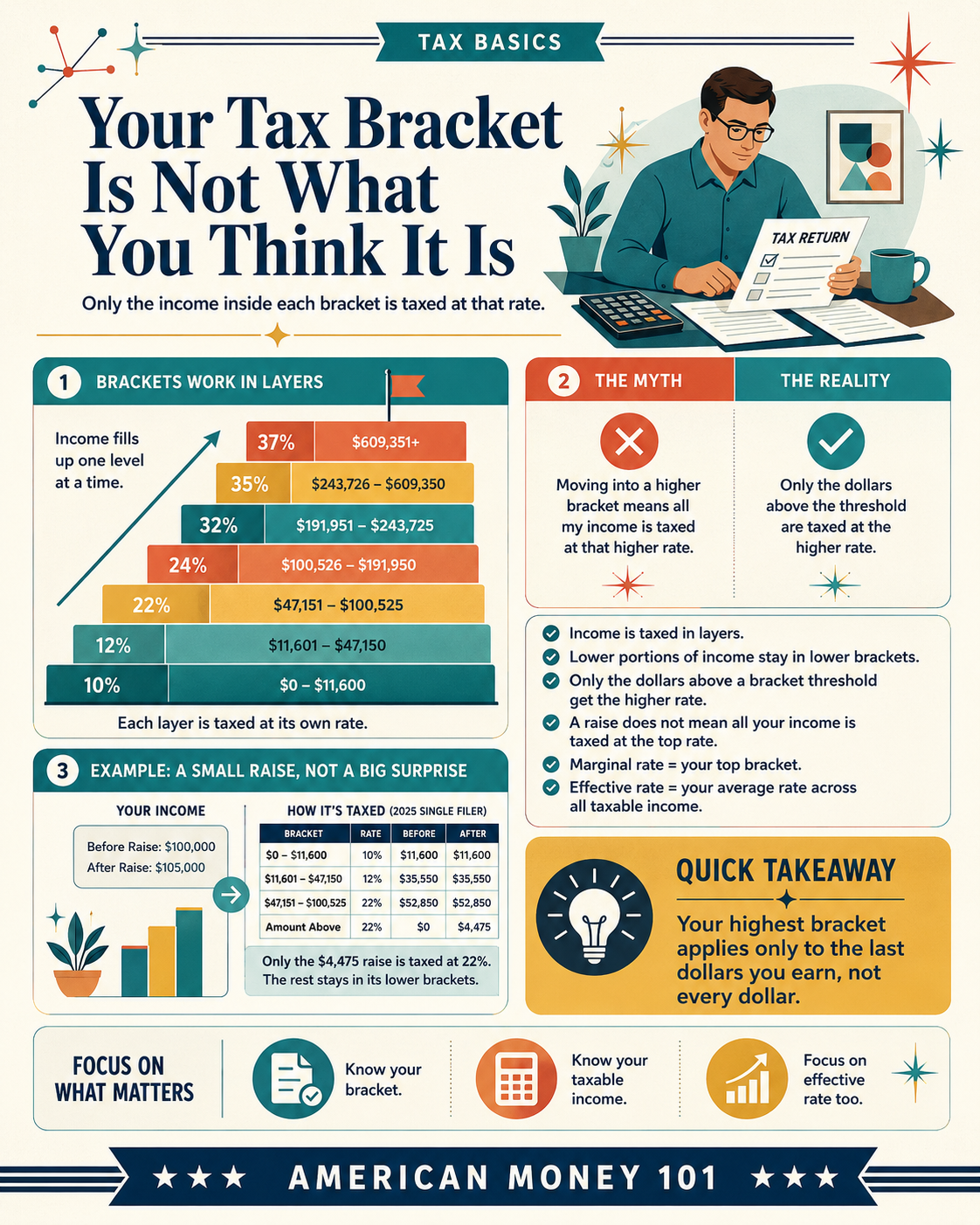
The biggest myth about taxes is that moving into a higher bracket means all your income is taxed at that higher rate. The reality is much less punishing. The United States uses a progressive tax system, which means your income is taxed in layers, or chunks. Only the dollars that fall above a specific bracket threshold get taxed at the higher rate.
- Income is taxed in layers.
- Lower portions of income stay in lower brackets.
- Only the dollars above a bracket threshold get the higher rate.
- A raise does not mean all your income is taxed at the top rate.
How Brackets Work in Layers
Think of tax brackets like a series of buckets that you fill up with your income one at a time. Once the first bucket is full, the overflow goes into the next bucket, which has a slightly higher tax rate. But the money in the first bucket is still taxed at the lower rate.
For example, looking at the 2024 tax brackets for a single filer (which the infographic uses for its illustration):
- 10%: $0 – $11,600
- 12%: $11,601 – $47,150
- 22%: $47,151 – $100,525
- 24%: $100,526 – $191,950
- 32%: $191,951 – $243,725
- 35%: $243,726 – $609,350
- 37%: $609,351+
Note: The IRS adjusts these figures annually for inflation. For the 2025 tax year, the 10% bracket covers up to $11,925, and the 12% bracket goes up to $48,475 for single filers.
Example: A Small Raise, Not a Big Surprise
Let's look at a practical example to see how this layered system protects your income. Imagine you are a single filer with a taxable income of $100,000. You get a $5,000 raise, bringing your new taxable income to $105,000.
Before the raise, your income filled up the 10% and 12% brackets, and the remainder sat in the 22% bracket. When you get that $5,000 raise, it pushes your total income past the $100,525 threshold (using the 2024 numbers from the graphic) and into the 24% bracket.
However, only the amount that spills over into that new bracket is taxed at 24%. The vast majority of your income is still taxed at 10%, 12%, and 22%. The raise is a net positive for your bank account; you will never lose money by getting a raise just because you crossed into a new tax bracket.
Marginal Rate vs. Effective Rate
To truly understand your tax situation, you need to know the difference between two key terms: marginal tax rate and effective tax rate.
- Marginal rate: This is your top bracket. It is the tax rate you pay on the last dollar you earn. If your income reaches into the 24% bracket, your marginal rate is 24%.
- Effective rate: This is your average rate across all your taxable income. Because your income is taxed in layers starting at 10%, your effective tax rate will always be lower than your marginal tax rate.
Focus on What Matters
When planning your finances, do not let the fear of a higher tax bracket hold you back from earning more money. Instead, focus on understanding your taxable income (your gross income minus deductions). Know your marginal bracket so you can estimate the tax impact of a bonus or a side hustle, but also calculate your effective rate to see the true, blended percentage of your income that goes to federal taxes.