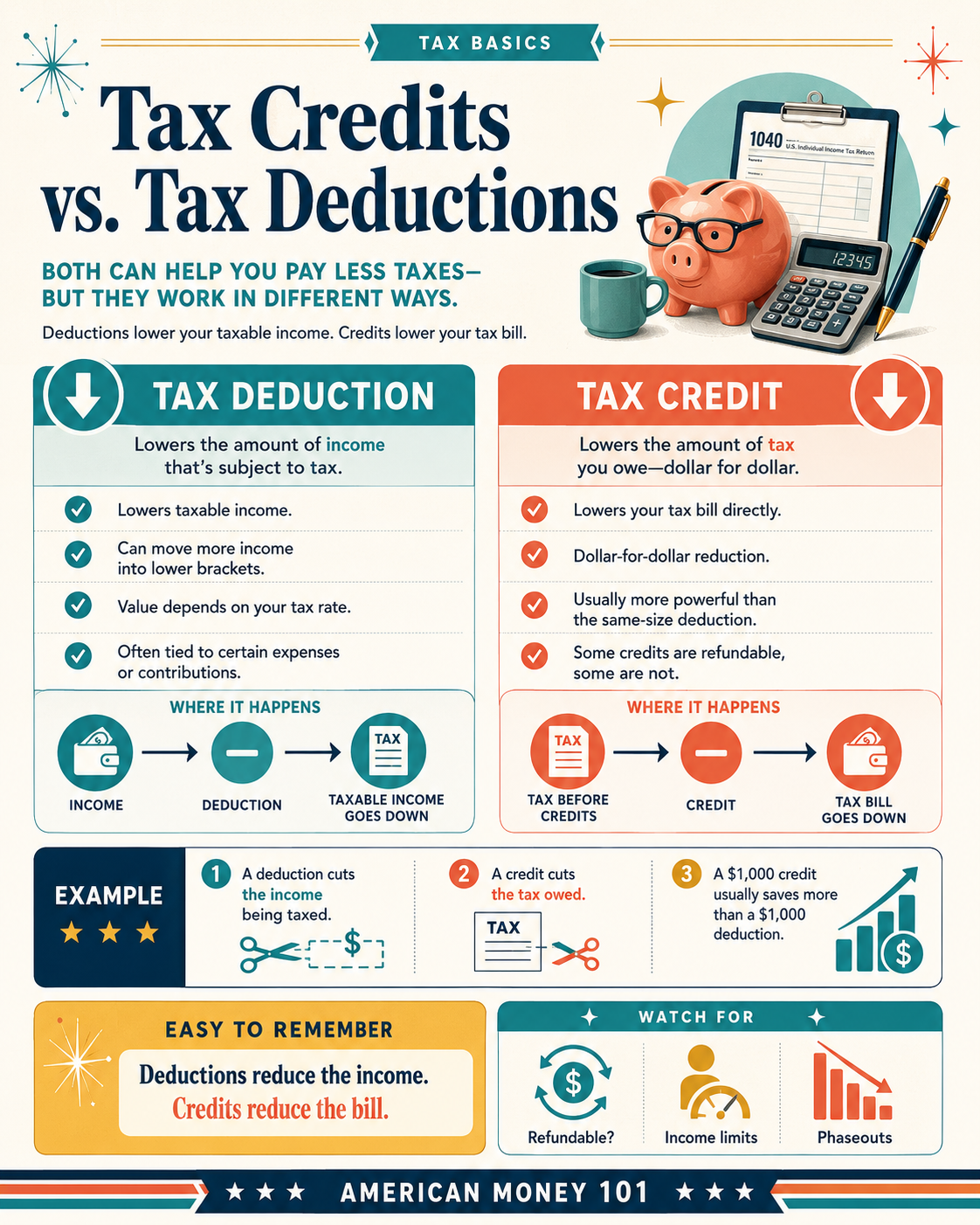
When tax season rolls around, you are probably looking for every legal way to keep more of your hard-earned money. You have likely heard the terms "tax deduction" and "tax credit" thrown around, often interchangeably. But what is the actual difference between a tax credit and a tax deduction? Both can help you pay less in taxes, but they work in fundamentally different ways. Deductions lower your taxable income, while credits lower your tax bill directly.
How Tax Deductions Work
A tax deduction lowers the amount of your income that is subject to tax. Think of it as shrinking the pie before the IRS takes its slice. When you claim a deduction, your taxable income goes down.
- Lowers taxable income: Deductions are subtracted from your gross income.
- Can move more income into lower brackets: By reducing your taxable income, deductions might drop you into a lower marginal tax bracket.
- Value depends on your tax rate: The actual cash value of a deduction depends on your top tax bracket. If you are in the 22% tax bracket, a $1,000 deduction saves you $220 in taxes.
- Often tied to certain expenses or contributions: Deductions are frequently linked to specific financial moves, like contributing to a traditional IRA, paying student loan interest, or making charitable donations.
The process is straightforward: Income minus Deduction equals Taxable Income Goes Down.
How Tax Credits Work
While a deduction reduces the income you are taxed on, a tax credit lowers the amount of tax you owe—dollar for dollar. It is a direct reduction of your final tax bill.
- Lowers your tax bill directly: Credits are applied after your tax liability is calculated.
- Dollar-for-dollar reduction: A $1,000 tax credit reduces your tax bill by exactly $1,000.
- Usually more powerful than the same-size deduction: Because credits reduce the tax owed directly rather than just the income being taxed, a credit almost always saves you more money than a deduction of the exact same amount.
- Some credits are refundable, some are not: This is a crucial distinction that determines how much money you can actually get back.
The process here is: Tax Before Credits minus Credit equals Tax Bill Goes Down.
Refundable vs. Nonrefundable Tax Credits
Not all tax credits are created equal. The IRS divides them into two main categories: nonrefundable and refundable.
Nonrefundable Tax Credits: These credits can reduce your tax bill to zero, but no further. If you owe $500 in taxes and have a $1,000 nonrefundable credit, your tax bill becomes zero, but you do not get the remaining $500 as a refund. It simply disappears (though some credits allow you to carry the unused portion forward to future years).
Refundable Tax Credits: These are the most valuable type of credit. If a refundable credit reduces your tax bill below zero, the IRS sends you the difference as a refund check. Using the same example, if you owe $500 and have a $1,000 refundable credit, your tax bill drops to zero, and you receive a $500 refund. Common examples include the Earned Income Tax Credit (EITC) and portions of the Child Tax Credit.
Things to Watch For
When planning your taxes, keep an eye out for a few common hurdles that can affect your ability to claim deductions and credits:
- Refundability: Always check if a credit you are targeting is refundable, partially refundable, or nonrefundable.
- Income limits: Many deductions and credits are designed for low- to moderate-income taxpayers. If you earn too much, you may not qualify.
- Phaseouts: Even if you do not hit the hard income limit, the value of many tax benefits gradually decreases (phases out) as your income rises.
The Bottom Line
The easiest way to remember the difference is this: Deductions reduce the income. Credits reduce the bill. A deduction cuts the income being taxed, while a credit cuts the tax owed. Because of this, a $1,000 credit usually saves more than a $1,000 deduction. By understanding how both mechanisms work, you can better plan your finances throughout the year and ensure you are taking advantage of every tax break you deserve.