How do you turn a losing investment into a tangible financial advantage? Tax-loss harvesting is a strategy that allows you to use your investment losses to offset your capital gains and potentially lower your ordinary income tax bill. By strategically selling underperforming assets, you can improve your after-tax results without breaking your long-term investment plan. While nobody likes seeing their portfolio drop, understanding how to harvest those losses can help you make the most of a difficult market environment.
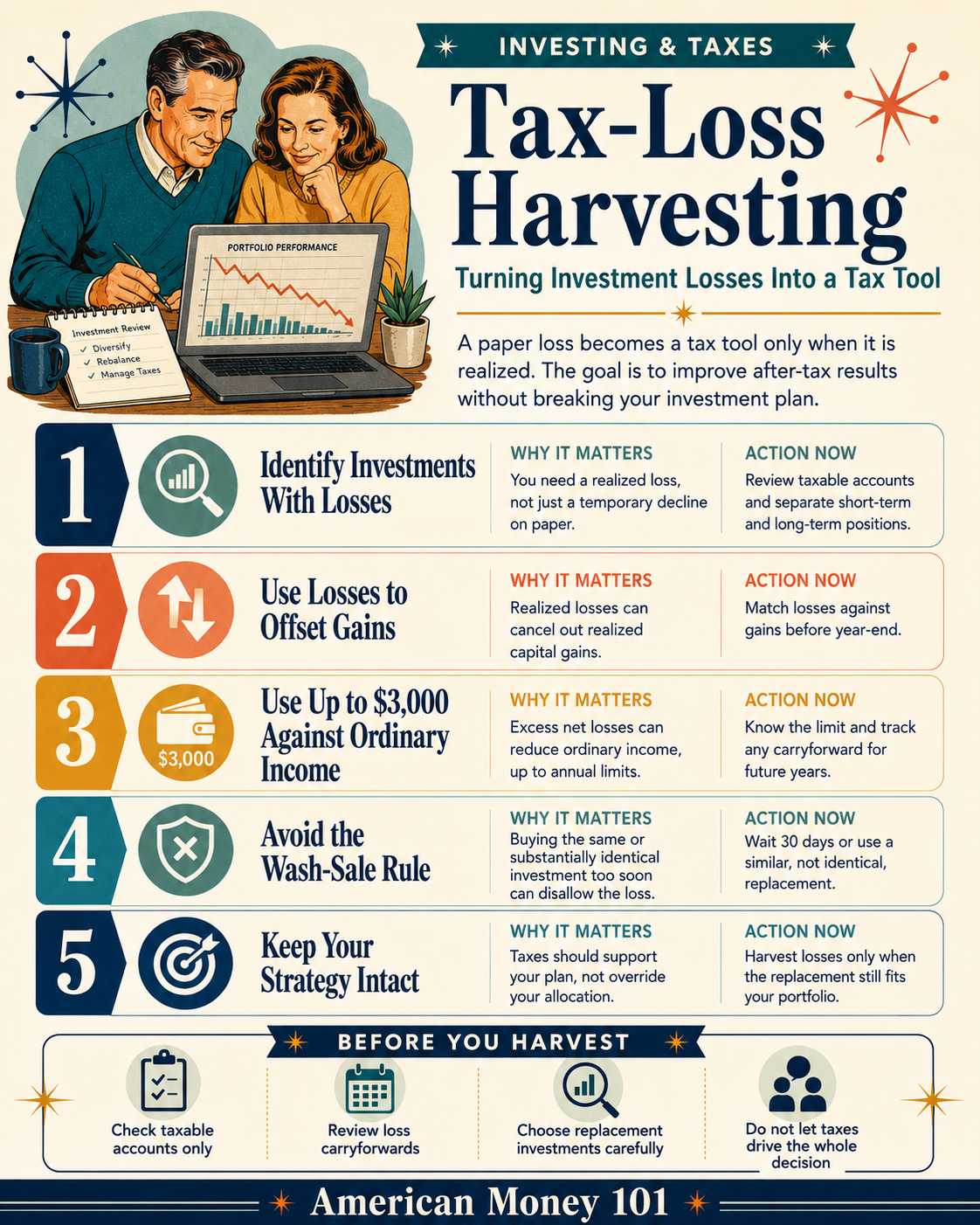
Identify Investments With Losses
A paper loss is just a decline in value on your screen. It becomes a tax tool only when it is realized—meaning you actually sell the asset. To begin tax-loss harvesting, you need to review your taxable accounts and identify investments that are currently worth less than what you paid for them. It is important to note that this strategy only applies to taxable brokerage accounts. Losses in tax-advantaged accounts, such as a 401(k) or an Individual Retirement Account (IRA), cannot be deducted from your taxes.
As you review your portfolio, you must separate your short-term and long-term positions. Short-term investments are those you have held for one year or less, while long-term investments are those held for more than one year. This distinction is critical because short-term capital gains are taxed at ordinary income rates, which are typically much higher than the favorable tax rates applied to long-term capital gains. Therefore, finding short-term losses to offset short-term gains can be particularly valuable for your overall tax picture.
Use Losses to Offset Gains
The primary benefit of tax-loss harvesting is that realized losses can cancel out realized capital gains. When you sell an investment for a profit, you owe capital gains taxes on that profit. By selling another investment at a loss, you can offset those gains and reduce your tax liability. You should aim to match your losses against your gains before the year ends to maximize your tax efficiency.
The IRS requires a specific matching process. You must first use short-term losses to offset short-term gains, and long-term losses to offset long-term gains. If you have excess losses in one category after that initial matching, those remaining losses can then cross over to offset gains in the other category. For example, if you realize a $5,000 short-term capital gain from selling a stock, you might owe a significant amount in taxes depending on your income bracket. If you also sell an underperforming mutual fund for a $4,000 short-term loss, your taxable short-term gain is reduced to just $1,000.
Use Up to $3,000 Against Ordinary Income
If your total capital losses exceed your total capital gains for the year, the tax benefits do not stop there. You can use the excess net losses to reduce your ordinary income, up to annual limits. The IRS allows you to deduct up to $3,000 of net capital losses against your ordinary income each year. If you are married but filing separately, that limit is reduced to $1,500.
You need to know this limit and track any carryforward for future years. If your net losses exceed the $3,000 annual limit, the remaining amount is not lost forever. You can carry it forward to subsequent tax years. Imagine you have $10,000 in net capital losses after offsetting all your capital gains for the year. You can apply $3,000 of that loss to reduce your ordinary income for the current tax year. The remaining $7,000 becomes a loss carryforward. Next year, you can use that $7,000 to offset new capital gains, or if you have no gains, you can deduct another $3,000 against your ordinary income, carrying the remaining $4,000 forward again.
Avoid the Wash-Sale Rule
The IRS has strict rules to prevent investors from gaming the system. The wash-sale rule dictates that buying the same or a substantially identical investment too soon can disallow the loss for tax purposes. Specifically, you cannot claim a loss if you purchase a substantially identical security within a 61-day window that begins 30 days before the sale and ends 30 days after the sale.
To avoid this trap, you must wait at least 31 days before repurchasing the asset, or use a similar, not identical, replacement. If you want to maintain your exposure to a specific sector or asset class, you can purchase a different security that serves a similar purpose in your portfolio. It is also crucial to understand that the wash-sale rule applies across all your accounts, including those held by your spouse. You cannot sell a stock at a loss in your taxable brokerage account and immediately buy the exact same stock in your IRA. The IRS will still flag this as a wash sale, and your tax deduction will be disallowed.
Keep Your Strategy Intact
Taxes should support your plan, not override your allocation. The primary goal of investing is to build wealth, and tax optimization is just one tool to help you get there. You should harvest losses only when the replacement still fits your portfolio. Do not sell an asset simply to get a tax break if it ruins your asset allocation or exposes you to unintended risks.
Before you execute any trades for tax purposes, run through a quick checklist to ensure you are making a sound financial decision:
- Check taxable accounts only: Remember that tax-loss harvesting provides no benefit in retirement accounts.
- Review loss carryforwards: Check your previous tax returns to see if you already have unused capital losses carried over from prior years.
- Choose replacement investments carefully: Ensure your new investments align with your risk tolerance and long-term goals while avoiding the wash-sale rule.
- Do not let taxes drive the whole decision: An investment should make sense on its own merits. Never let the desire for a tax deduction push you into a poor investment choice.