Paying off your mortgage is a massive financial achievement. You finally own your home free and clear, and you no longer have to send a large check to the bank every month. But if you think your housing costs are dropping to zero, you might be in for a surprise. Why does your property tax bill keep rising even after you pay off your mortgage?
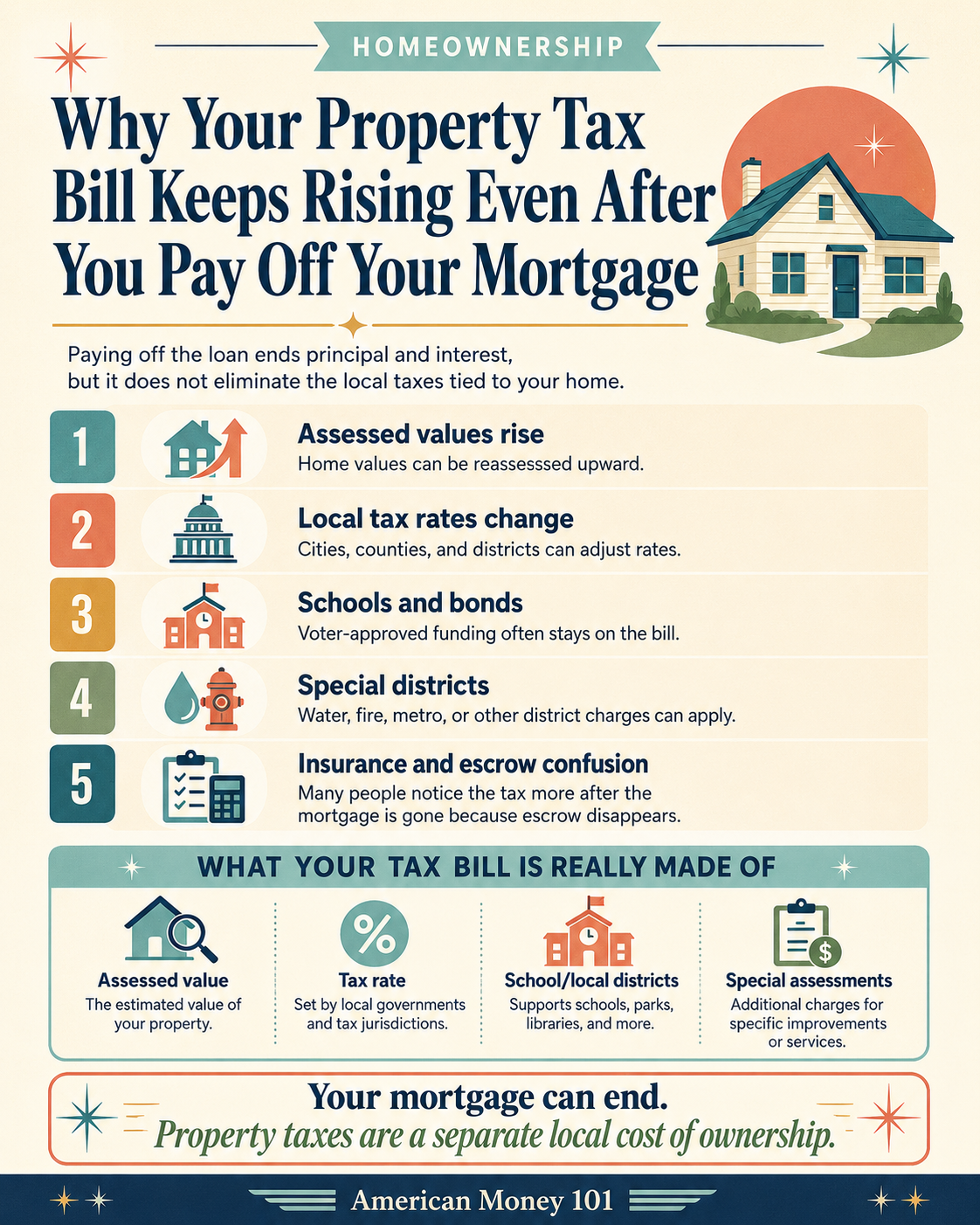
The short answer is that property taxes are completely separate from your mortgage. Paying off the loan ends your principal and interest payments, but it does not eliminate the local taxes tied to your home. In fact, those taxes are likely to keep going up. Here is a breakdown of why your property tax bill continues to rise and what it is really made of.
Assessed Values Rise
Your property tax bill is heavily influenced by the assessed value of your home. This is the dollar amount your local tax assessor assigns to your property for tax purposes. It is not necessarily the same as the market value (what you could sell the house for) or the appraised value (what a lender uses to approve a mortgage), though they are related.
As home values in your area increase, your local government may reassess your property upward. If your home's assessed value goes up, your tax bill will likely go up as well, even if the tax rate stays exactly the same. Major renovations, like adding a bedroom or finishing a basement, can also increase your home's assessed value.
Local Tax Rates Change
The other major factor in your property tax bill is the tax rate itself, sometimes called the millage rate. This rate is set by your local government—including cities, counties, and various districts—to fund public services. If the cost of providing those services goes up, the local government may vote to increase the tax rate.
Property taxes are a primary source of revenue for local governments. They pay for essential services like:
- Police and fire departments
- Road maintenance and infrastructure
- Public parks and libraries
- Trash collection and sanitation
When cities and counties need more money to cover these costs, they often adjust the tax rates upward, which directly increases your bill.
Schools and Bonds
A significant portion of your property tax bill usually goes toward funding local public schools. School districts rely heavily on property taxes to pay for teachers, buildings, supplies, and other educational costs. If the school district's budget increases, your taxes may increase to cover the difference.
Additionally, voter-approved funding often stays on the bill for years. When your community votes to pass a bond measure—perhaps to build a new high school or upgrade local infrastructure—that cost is passed on to homeowners through property taxes. These bonds can take decades to pay off, meaning the extra charge will remain on your tax bill long after your mortgage is gone.
Special Districts
Depending on where you live, you may also be subject to taxes from special districts. These are separate local government units created to provide specific services to a defined area. Examples include:
- Water and sewer districts
- Fire protection districts
- Metro or transit districts
- Flood control districts
These special districts have the authority to levy their own taxes or fees, which are added to your overall property tax bill. If a special district raises its rates or if a new district is formed in your area, your total tax burden will increase.
Insurance and Escrow Confusion
Many people notice the tax more after the mortgage is gone because the escrow account disappears. When you have a mortgage, your lender typically requires you to pay a portion of your estimated annual property taxes and homeowners insurance each month. The lender holds this money in an escrow account and pays the bills on your behalf when they are due.
Because the taxes are bundled into a single monthly payment with your principal and interest, it is easy to lose track of exactly how much you are paying in taxes versus the loan itself. When you pay off the mortgage, the lender stops collecting escrow. Suddenly, you are responsible for paying the property tax bill directly to the local government, often in one or two large lump sums each year. The sticker shock of seeing the full bill all at once can make it feel like the taxes have suddenly skyrocketed, even if they have only increased gradually.
What Your Tax Bill Is Really Made Of
To understand why your bill is rising, it helps to know exactly what goes into it. Your property tax bill is generally made of four main components:
- Assessed value: The estimated value of your property, determined by the local assessor.
- Tax rate: The percentage set by local governments and tax jurisdictions.
- School/local districts: The portion that supports schools, parks, libraries, and other community services.
- Special assessments: Additional charges for specific local improvements or services, like a new sewer line or street paving.
Your mortgage can end, but property taxes are a separate, ongoing local cost of ownership. By understanding how assessed values, tax rates, and local districts work together, you can better anticipate future tax increases and budget accordingly for your life as a debt-free homeowner.
Sources and further reading
- What is property tax? | Rocket Mortgage
- 4 factors that lead to a property tax increase | Rocket Mortgage
- Assessed value: What it is and how it’s determined | Rocket Mortgage
- Are property taxes included in the mortgage? What to know
- Annual Escrow Analysis: Why Your Mortgage Payments May Have Changed - NerdWallet
- Are Property Taxes Included in Mortgage Payments? | SoFi