When the utility bill arrives, it is natural to look for ways to trim the fat. You might start closing vents in unused rooms, hand-washing your dishes, or leaving the ceiling fan running all day. These habits sound smart, but many barely help or can actually backfire, driving your energy costs up instead of down. Understanding how your home's systems actually work is the key to lowering your bills.
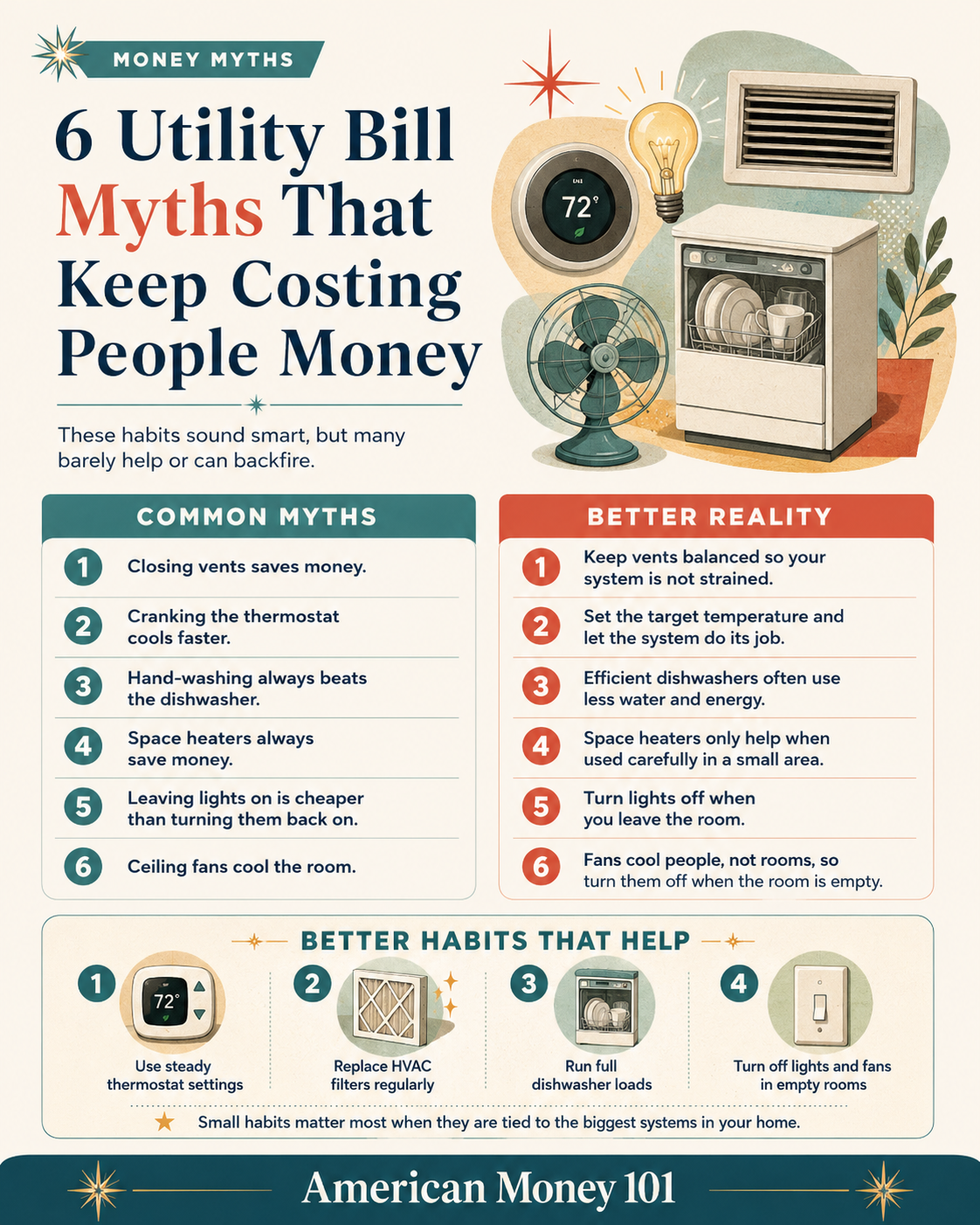
Myth 1: Closing Vents Saves Money
It seems logical: if you are not using the guest room, why pay to heat or cool it? However, closing vents does not save money. Your heating, ventilation, and air conditioning (HVAC) system is designed to distribute a specific amount of air throughout your home. When you close vents, you increase the air pressure inside the ductwork. This forces the system's blower to work harder to push the same amount of air, which uses more energy and can eventually damage the equipment. The better reality is to keep your vents open and balanced so your system is not strained.
Myth 2: Cranking the Thermostat Cools Faster
When you walk into a sweltering house, you might be tempted to drop the thermostat to 60 degrees, hoping it will cool the house down faster than if you set it to 72. This is a misunderstanding of how air conditioners work. Your AC unit cools at a constant rate; it does not work "harder" or "faster" when you set the temperature lower. It simply runs longer until it reaches the target temperature. If you forget to turn it back up, the system will keep running, wasting energy and money. Set the target temperature you actually want and let the system do its job.
Myth 3: Hand-Washing Always Beats the Dishwasher
Washing dishes by hand feels like the frugal choice, but it is usually a waste of both water and energy. Modern, efficient dishwashers use significantly less water than a running tap. According to the EPA's Energy Star program, using an Energy Star certified dishwasher can save thousands of gallons of water a year compared to washing by hand. Because heating water accounts for a large portion of your energy bill, using less hot water translates directly to savings. Efficient dishwashers often use less water and energy, provided you run full loads.
Myth 4: Space Heaters Always Save Money
Space heaters are often touted as a cheap way to stay warm, but electricity is generally a more expensive way to heat a space than natural gas or a central heat pump. Space heaters only help when used carefully in a small area. If you turn down your central heating system significantly and use a space heater to warm just the room you are occupying, you might save money. But if you run multiple space heaters or use one while keeping the rest of the house at a normal temperature, your electric bill will likely spike.
Myth 5: Leaving Lights On Is Cheaper Than Turning Them Back On
There is an old myth that the surge of electricity required to turn on a light bulb uses more energy than simply leaving the bulb on. This is false. The tiny fraction of a second of extra power used to turn on a light is negligible. Leaving a light on always uses more electricity than turning it off. The rule is simple: turn lights off when you leave the room.
Myth 6: Ceiling Fans Cool the Room
Walking into a room with a ceiling fan running feels cooler, but the fan is not actually lowering the temperature of the room. Fans cool people, not rooms. The breeze from the fan helps evaporate moisture from your skin, making you feel cooler. If the room is empty, the fan is just burning electricity without providing any benefit. Turn ceiling fans off when the room is empty.
Better Habits That Actually Help
Small habits matter most when they are tied to the biggest systems in your home. Instead of relying on myths, focus on these proven strategies:
- Use steady thermostat settings: Avoid drastic temperature swings. Consider a programmable thermostat to manage temperatures efficiently when you are asleep or away.
- Replace HVAC filters regularly: A dirty filter restricts airflow, forcing your system to work harder and use more energy. Check your filter monthly and replace it as needed.
- Run full dishwasher loads: Maximize the efficiency of your dishwasher by only running it when it is completely full.
- Turn off lights and fans in empty rooms: Make it a habit to flip the switch whenever you leave a space.