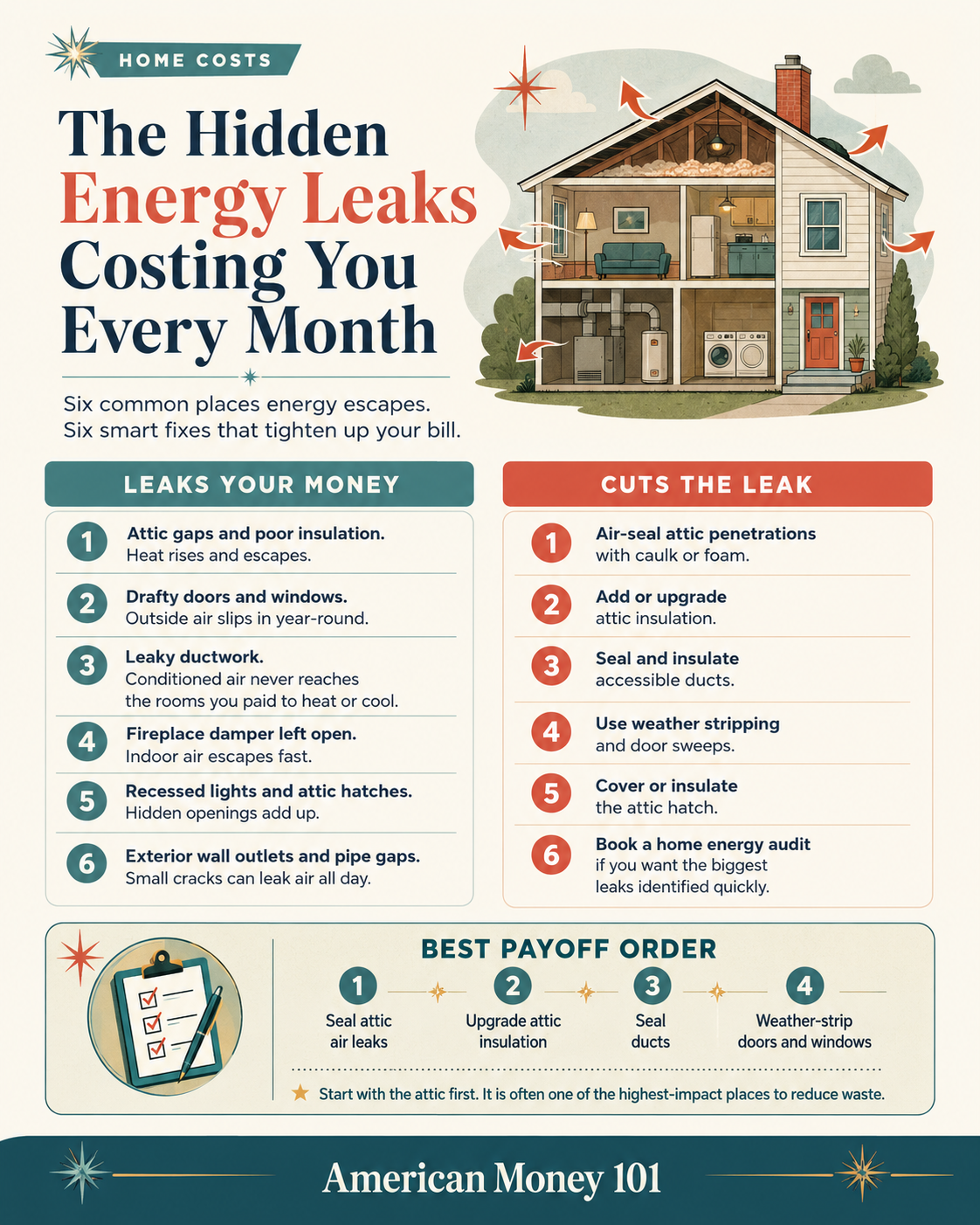
If you feel like your utility bills are creeping up, you are not alone. But before you blame rising energy costs entirely, take a look around your house. You might be paying to heat and cool the outdoors. The infographic "The Hidden Energy Leaks Costing You Every Month" highlights six common places where energy escapes and offers smart fixes to help you tighten up your bill.
Where Your Money Leaks Out
Energy loss happens in almost every home, often in places you don't see or think about daily. Here are the six main culprits:
- Attic gaps and poor insulation: Heat rises. If your attic isn't properly sealed and insulated, the warm air you paid for goes right through the roof.
- Drafty doors and windows: Outside air slips in year-round through worn-out seals, making your heating and cooling systems work overtime.
- Leaky ductwork: Conditioned air never reaches the rooms you paid to heat or cool if it escapes through gaps in your ducts first.
- Fireplace damper left open: An open damper is like an open window; indoor air escapes fast.
- Recessed lights and attic hatches: These hidden openings add up, allowing air to flow freely between your living space and the unconditioned attic.
- Exterior wall outlets and pipe gaps: Small cracks around plumbing and electrical penetrations can leak air all day long.
Smart Fixes to Cut the Leaks
You don't always need a major renovation to stop energy waste. Many of these leaks can be fixed with a quick trip to the hardware store and a little elbow grease. Here is how you can cut the leaks:
- Air-seal attic penetrations: Use caulk or expanding foam to seal gaps around pipes, wires, and vents that go into the attic.
- Add or upgrade attic insulation: Once air leaks are sealed, ensure your attic has enough insulation to keep the heat where it belongs.
- Seal and insulate accessible ducts: Use mastic sealant or metal tape (not standard duct tape) to seal joints in your ductwork, especially in unconditioned spaces like basements or crawlspaces.
- Use weather stripping and door sweeps: Block drafts around doors and windows to keep outside air out.
- Cover or insulate the attic hatch: Treat the attic access door like an exterior door by adding weather stripping and insulation to the back of it.
- Book a home energy audit: If you want the biggest leaks identified quickly, a professional audit can pinpoint exactly where your home is losing energy. According to the Department of Energy, making upgrades identified in an assessment can save 5% to 30% on your monthly energy bill.
The Best Payoff Order
If you are ready to tackle these projects, it helps to know where to start for the biggest impact. The infographic suggests this payoff order:
- Seal attic air leaks: Start with the attic first. It is often one of the highest-impact places to reduce waste.
- Upgrade attic insulation: Do this only after sealing the air leaks.
- Seal ducts: Ensure the air you are paying to condition actually reaches your living spaces.
- Weather-strip doors and windows: Finish up by sealing the gaps you interact with every day.
Taking the Next Step
By sealing uncontrolled air leaks, you can save 10% to 20% on your heating and cooling bills, according to the Department of Energy's Energy Saver Guide. Whether you choose to DIY these fixes or hire a professional for a comprehensive energy audit, taking action now will make your home more comfortable and keep more money in your wallet month after month.