When you buy a house with another person, you are making a major financial commitment. But beyond the mortgage and the down payment, there is a crucial legal detail you must decide: how you will hold the title. The specific wording on your property deed answers a very important question: What happens to the home when one of the owners dies? The two most common ways to co-own property are joint tenancy and tenancy in common, and the difference between them can completely change who inherits your share of the house.
Understanding Joint Tenancy
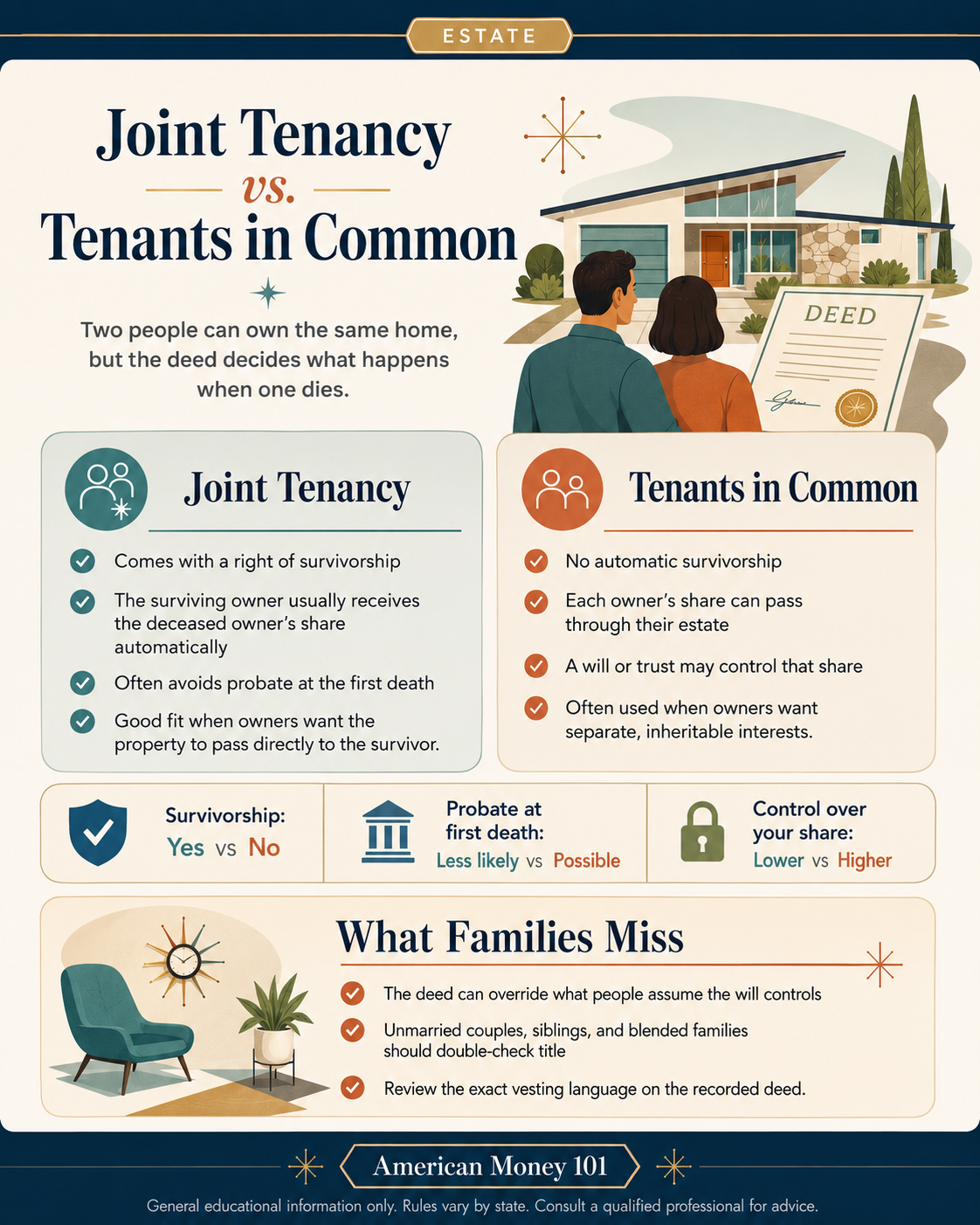
Joint tenancy is a form of co-ownership where all owners hold an equal share of the property. The defining feature of joint tenancy is the "right of survivorship." This means that when one owner dies, their share of the property automatically passes to the surviving owner or owners.
- Comes with a right of survivorship: The transfer of ownership happens by operation of law, immediately upon death.
- The surviving owner usually receives the deceased owner's share automatically: You do not need to go through a lengthy legal process to transfer the title.
- Often avoids probate at the first death: Because the transfer is automatic, the property does not become part of the deceased person's probate estate.
- Good fit when owners want the property to pass directly to the survivor: This is very common for married couples who want the surviving spouse to own the home outright without any legal hurdles.
While joint tenancy is convenient for avoiding probate, it means you give up control over who inherits your share. You cannot leave your portion of a joint tenancy property to someone else in your will; the survivorship right overrides the will.
Understanding Tenants in Common
Tenancy in common (often abbreviated as TIC) is another way to share ownership, but it operates very differently when an owner passes away. In a tenancy in common, each owner holds a distinct, fractional share of the property. These shares do not have to be equal; one person could own 70% while the other owns 30%.
- No automatic survivorship: When a tenant in common dies, their share does not automatically go to the surviving co-owner.
- Each owner's share can pass through their estate: The deceased owner's portion becomes part of their estate and is distributed according to their wishes or state law.
- A will or trust may control that share: You have the power to dictate who inherits your specific percentage of the property.
- Often used when owners want separate, inheritable interests: This is a popular choice for friends buying property together, business partners, or people with children from previous relationships who want to ensure their kids inherit their share.
Because there is no automatic transfer, a tenancy in common share will likely have to go through the probate process before it can be transferred to the heirs.
Comparing the Key Differences
When deciding between these two forms of ownership, you are essentially weighing convenience against control. Here is how they stack up on three critical factors:
- Survivorship: Joint tenancy has it (Yes); tenancy in common does not (No).
- Probate at first death: With joint tenancy, probate is less likely because the transfer is automatic. With tenancy in common, probate is possible (and often required) to transfer the deceased owner's share.
- Control over your share: Joint tenancy offers lower control because you cannot will your share to a third party. Tenancy in common offers higher control, allowing you to leave your share to whomever you choose.
What Families Often Miss
Many people assume that having a will is enough to ensure their assets go to the right people. However, property law can be rigid, and the way a deed is written often takes precedence over other estate planning documents.
- The deed can override what people assume the will controls: If you hold property as joint tenants, a clause in your will trying to give your share to your child will generally be invalid. The surviving joint tenant will get the property.
- Unmarried couples, siblings, and blended families should double-check title: If you are in a blended family and own a home in joint tenancy with your new spouse, your children from a previous marriage will not inherit any part of that home when you die. It will all go to your surviving spouse.
- Review the exact vesting language on the recorded deed: Do not guess how you own your home. Look at the actual deed recorded with your county. It should explicitly state "as joint tenants with right of survivorship" or "as tenants in common." If the language is ambiguous, state law will dictate the default (which is often tenancy in common, but rules vary by state).
Choosing how to hold title is a significant legal decision. If you are unsure which option is best for your situation, or if you need to change how your property is currently vested, it is always wise to consult with a qualified real estate or estate planning attorney in your state.
Sources and further reading
- joint tenancy | Wex | US Law | LII / Legal Information Institute
- tenancy in common | Wex | US Law | LII / Legal Information Institute
- Tenancy in common vs joint tenancy
- Joint Tenants vs Tenants in Common - Gordons Partnership
- Tenancy in common vs. joint tenants | Rocket Mortgage
- Tenancy In Common vs Joint Tenancy - First Integrity Title Company