When you are planning for retirement, it can feel like you are navigating a minefield of numbers. You have probably heard various ages thrown around—55, 59½, 62, 65, 67, 70, and 73. Each of these milestones unlocks different rules, benefits, or penalties. Mixing them up can be a costly mistake. Let's break down exactly what happens at each of these critical retirement ages so you can avoid expensive errors and keep more of your hard-earned money.
Age 55: The Rule of 55
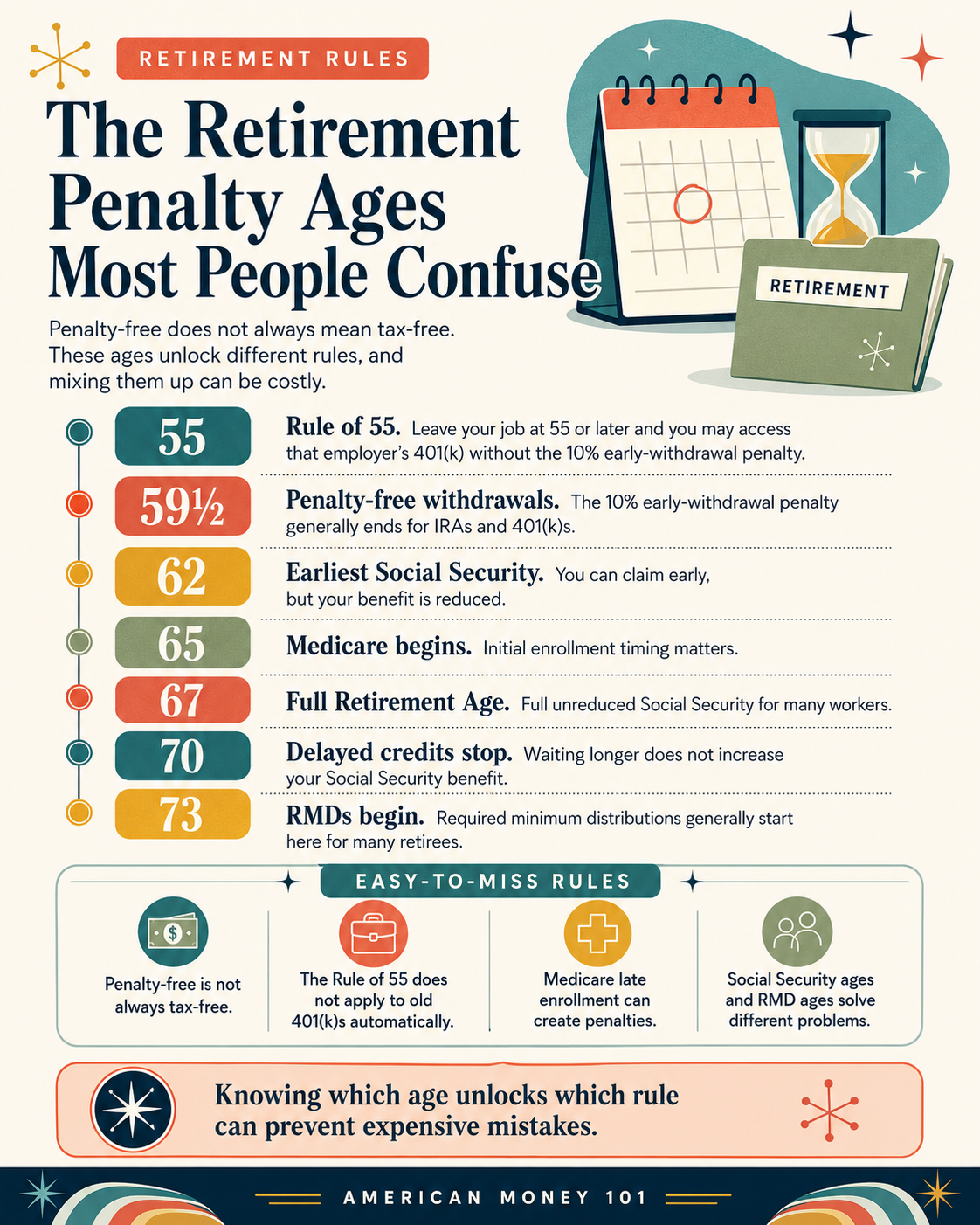
If you leave your job in the year you turn 55 or older, you might be able to tap into your 401(k) without facing the standard 10% early-withdrawal penalty. This is commonly known as the Rule of 55. It does not matter if you quit, were fired, or laid off. However, there are some important catches:
- It only applies to your current employer's plan. You cannot use this rule to pull money penalty-free from an old 401(k) left at a previous employer.
- Penalty-free does not mean tax-free. You will still owe regular income tax on the money you withdraw.
- Not all plans allow it. You need to check with your specific plan administrator to ensure they support partial withdrawals under this rule.
Age 59½: The End of the Early-Withdrawal Penalty
For most people, age 59½ is the magic number for retirement accounts. Once you hit this half-birthday, the IRS generally stops charging the 10% early-withdrawal penalty on money you take out of your traditional IRAs and 401(k)s. Just remember, while the penalty is gone, the taxes are not. Any money you pull from a traditional, tax-deferred account will be taxed as ordinary income in the year you withdraw it.
Ages 62, 67, and 70: The Social Security Milestones
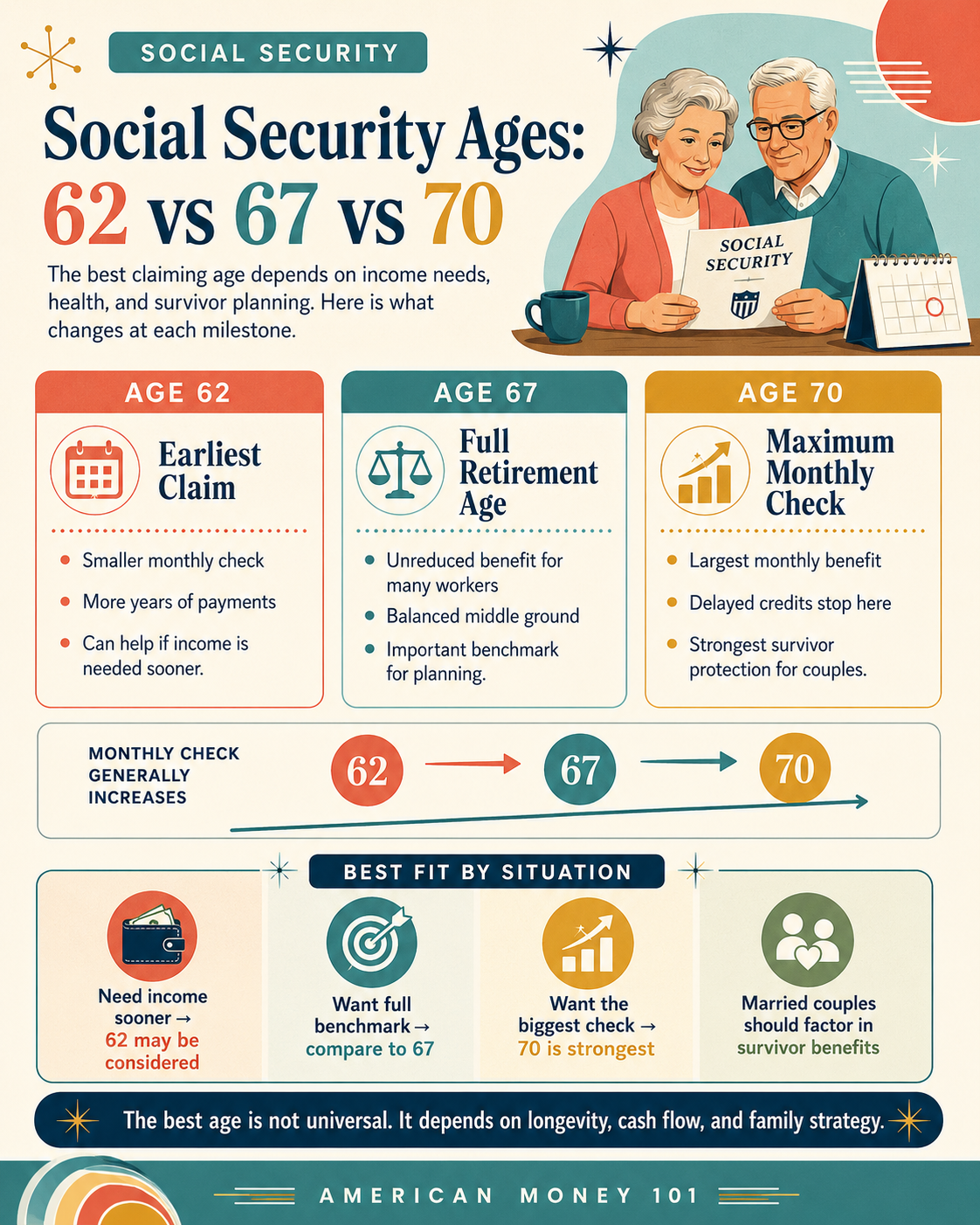
Social Security is not a one-size-fits-all age. You have a window of time to start claiming, and when you choose to start has a permanent impact on your monthly check.
- Age 62: Earliest Social Security. This is the earliest you can claim your retirement benefits. However, if you claim at 62, your monthly benefit will be permanently reduced—often by up to 30% compared to what you would get at your Full Retirement Age.
- Age 67: Full Retirement Age (FRA). For anyone born in 1960 or later, 67 is your Full Retirement Age. This is the age when you are entitled to 100% of your calculated Social Security benefit.
- Age 70: Delayed Credits Stop. If you wait past your FRA to claim Social Security, your benefit increases by 8% for every year you delay. But those delayed retirement credits stop accumulating at age 70. There is no financial benefit to waiting past 70 to claim your Social Security.
Age 65: Medicare Begins
Age 65 is your trigger for Medicare. Your Initial Enrollment Period (IEP) is a seven-month window that includes the three months before your 65th birthday month, the month you turn 65, and the three months after. Timing matters here. If you miss your initial enrollment window and do not have qualifying other health coverage (like from a current employer), you could face permanent late enrollment penalties that increase your Medicare premiums for the rest of your life.
Age 73: Required Minimum Distributions (RMDs) Begin
The IRS will not let you keep your money in tax-deferred accounts forever. Eventually, they want their tax revenue. This is where Required Minimum Distributions (RMDs) come in. Under current law, you generally must start taking RMDs from your traditional IRAs and 401(k)s at age 73.
- The penalty is steep. If you fail to take your RMD, the IRS can hit you with a penalty of up to 25% of the amount you were supposed to withdraw.
- Roth accounts are different. Original owners of Roth IRAs do not have to take RMDs during their lifetime.
Easy-to-Miss Rules to Remember
As you navigate these ages, keep these easy-to-miss rules in mind to prevent expensive mistakes:
- Penalty-free is not always tax-free. Avoiding a 10% penalty does not mean you avoid income taxes.
- The Rule of 55 does not apply to old 401(k)s automatically. You can only use it for the plan of the employer you leave at age 55 or older.
- Medicare late enrollment can create penalties. Missing your window at age 65 can cost you for life.
- Social Security ages and RMD ages solve different problems. Social Security is about when you get paid; RMDs are about when you must pay taxes on your savings.
Knowing which age unlocks which rule is the key to a smooth and financially secure retirement.