If you have money in a traditional IRA or 401(k), you might be wondering if you should move some of it into a Roth account before the year ends. A Roth conversion can lower your future taxes, but only if it fits your income, tax bracket, and long-term plan. Let's break down when a Roth conversion is a smart setup and when you need to use caution.
What Is a Roth Conversion?
A Roth conversion involves moving eligible pre-tax money from a traditional retirement account into a Roth IRA. Because you didn't pay taxes on that money when you contributed it, you have to pay ordinary income tax on the amount you convert in the year you do it. The tradeoff is that once the money is in the Roth account, it grows tax-free, and qualified withdrawals in retirement are also tax-free.
When a Roth Conversion Is a Smart Setup
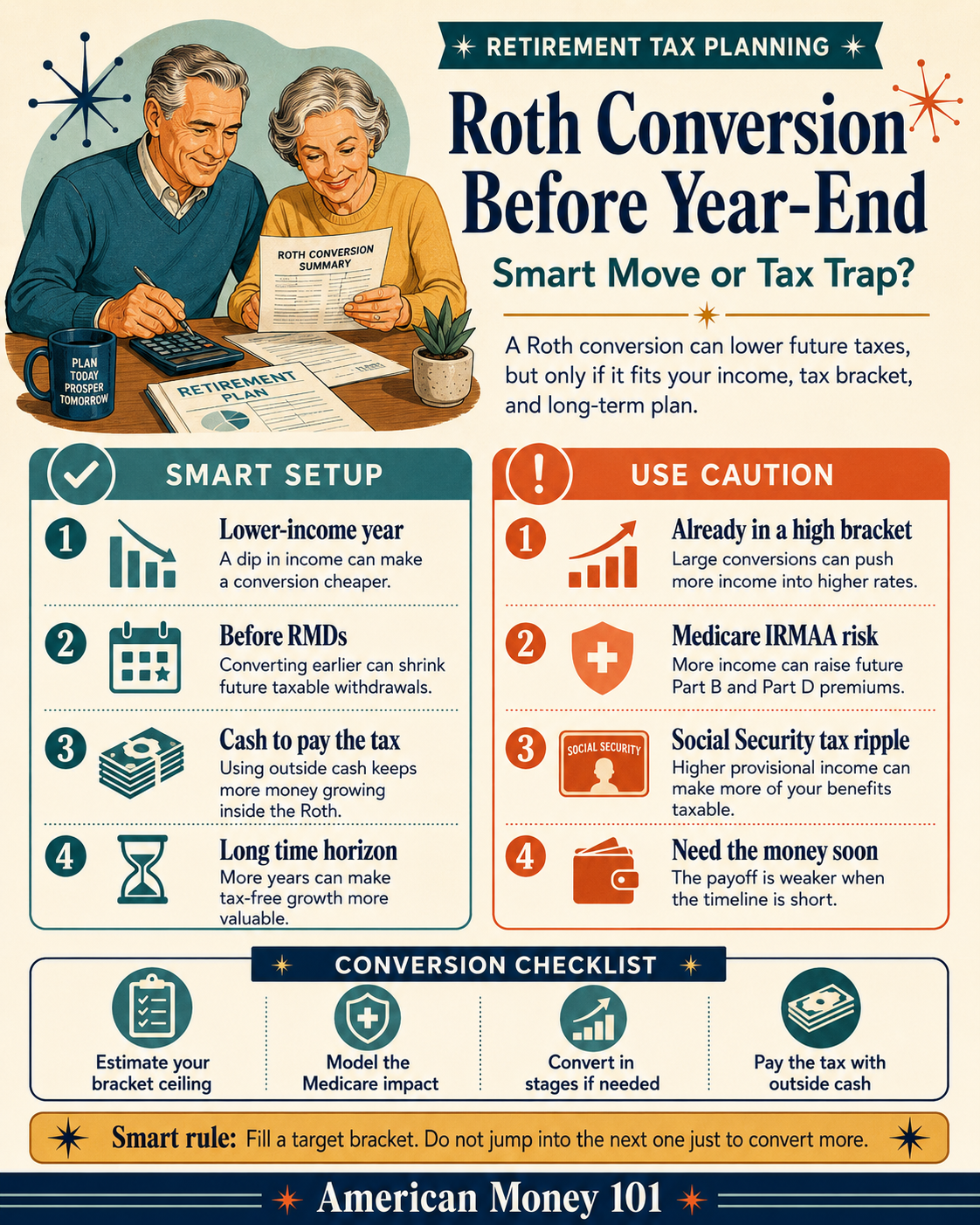
A Roth conversion isn't an all-or-nothing decision. You can convert a portion of your account, and doing so under the right conditions can be highly beneficial. Here are four scenarios where a conversion makes sense:
- Lower-income year: A dip in your income—perhaps due to a job change, a sabbatical, or retiring before you start claiming Social Security—can make a conversion cheaper because you'll pay taxes at a lower rate.
- Before RMDs: Converting earlier can shrink your future taxable withdrawals. Required Minimum Distributions (RMDs) force you to take money out of traditional accounts at a certain age, which can push you into a higher tax bracket later in life.
- Cash to pay the tax: Using outside cash to pay the tax bill keeps more money growing inside the Roth account. If you use funds from the conversion itself to pay the taxes, you lose out on the tax-free growth of those dollars.
- Long time horizon: More years can make tax-free growth more valuable. If you don't need the money soon, it has more time to compound without the drag of future taxes.
When to Use Caution
While the benefits of a Roth IRA are appealing, the upfront tax cost can sometimes outweigh the long-term gains. You should be careful about converting if any of the following apply:
- Already in a high bracket: Large conversions can push more of your income into higher tax rates. If you are currently in your peak earning years, it might be better to wait until your income drops in retirement.
- Medicare IRMAA risk: More income can raise your future Part B and Part D premiums. Medicare uses your modified adjusted gross income (MAGI) from two years prior to determine your premiums, and a large conversion could trigger the Income-Related Monthly Adjustment Amount (IRMAA).
- Social Security tax ripple: Higher provisional income can make more of your benefits taxable. Up to 85% of your Social Security benefits can be taxed depending on your income, and a Roth conversion adds to that calculation in the year you do it.
- Need the money soon: The payoff is weaker when the timeline is short. If you plan to spend the money in the next few years, you might not have enough time to recoup the taxes paid on the conversion through tax-free growth. Additionally, there is a 5-year waiting period before you can withdraw converted funds penalty-free if you are under age 59½.
Your Conversion Checklist
If you decide a Roth conversion is right for you, follow this checklist to execute it smoothly:
- Estimate your bracket ceiling: Figure out how much room you have in your current tax bracket before your income spills over into the next, higher rate.
- Model the Medicare impact: Check the IRMAA thresholds to ensure your conversion won't unexpectedly spike your Medicare premiums.
- Convert in stages if needed: You don't have to convert everything at once. Spreading the conversion over several years can help you manage the tax hit.
- Pay the tax with outside cash: Have funds ready in a regular savings or brokerage account to cover the tax bill.
The Smart Rule for Conversions
When planning your conversion, the smartest approach is to fill a target bracket. Calculate how much you can convert without jumping into the next tax bracket. Do not jump into the next one just to convert more. By carefully managing the amount you convert each year, you can maximize the benefits of a Roth IRA while minimizing the tax sting.