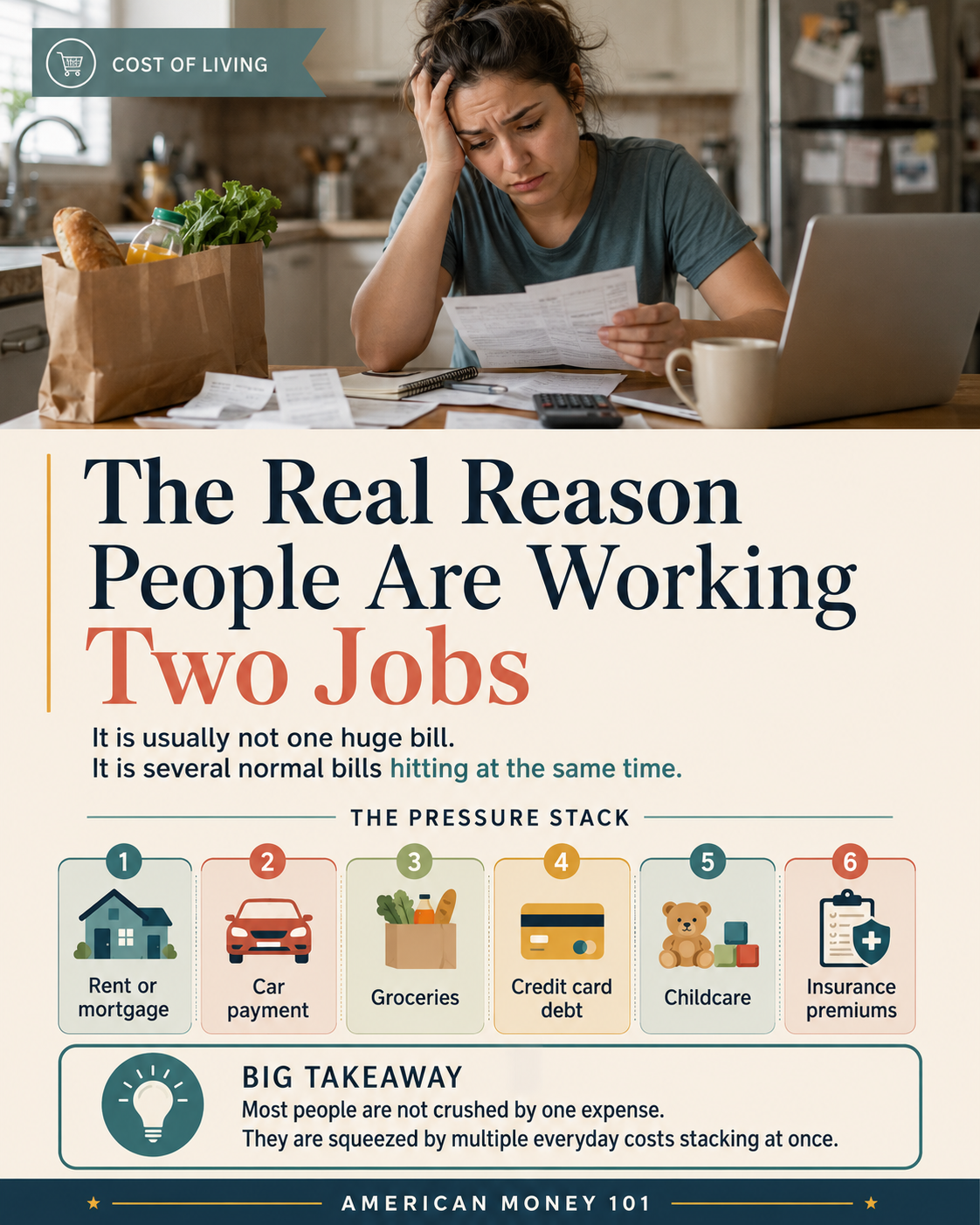
If you find yourself considering a second job, you are not alone. According to the U.S. Bureau of Labor Statistics, millions of Americans are working multiple jobs to make ends meet. But what is driving this trend? The infographic "The Real Reason People Are Working Two Jobs" answers this exact question. It is usually not one huge bill that pushes people to seek extra income. Instead, it is several normal bills hitting at the exact same time.
The Pressure Stack: Everyday Costs Adding Up
The core issue for many households is what we can call "The Pressure Stack." Most people are not crushed by a single, unexpected expense. They are squeezed by multiple everyday costs stacking up at once. When your paycheck arrives, it often feels like it is already spent before it even hits your bank account. The infographic identifies six common components of this pressure stack:
- Rent or mortgage: Housing is typically the largest monthly expense for any household.
- Car payment: Reliable transportation is essential for most people to get to work, making this a non-negotiable cost.
- Groceries: The cost of food has risen significantly, putting a strain on weekly budgets.
- Credit card debt: Minimum payments on credit cards can quickly eat into your available cash.
- Childcare: For working parents, childcare is a major, recurring expense.
- Insurance premiums: Health, auto, and home insurance are necessary protections that require regular payments.
Why Timing Matters More Than You Think
When these six expenses—rent, car payments, groceries, debt, childcare, and insurance—all demand payment within the same week, the financial pressure can be overwhelming. This is why many people feel forced to take on a second job. It is not necessarily that their primary income is insufficient to cover their total monthly expenses; it is that their cash flow cannot handle the simultaneous demand. If your rent is due on the 1st, your car payment on the 3rd, and your credit card bill on the 5th, a paycheck received on the 15th will not help you avoid late fees or the stress of a depleted bank account.
The Strategy of Staggered Payments
One effective way to alleviate the pressure stack without taking on a second job is to stagger your bill payments. Staggering payments means arranging your financial obligations so that they occur at different times throughout the month, aligning them more closely with your paydays. For example, if you are paid bi-weekly, you might aim to pay your rent and car payment with your first paycheck, and your credit card, childcare, and insurance with your second paycheck.
To implement this strategy, start by listing all your bills and their current due dates. Then, contact your creditors and service providers. Many companies, including credit card issuers and utility providers, will allow you to change your billing due date upon request. By spreading your due dates across the month, you can smooth out your cash flow and reduce the intense pressure of the first week of the month.
Organizing Your Financial Obligations
Beyond staggering payments, getting organized is crucial. Often, the problem is not just the amount you owe, but the disorganization around it. Take the time to track your spending and categorize your expenses into fixed costs (like rent and insurance) and variable costs (like groceries and entertainment). Using a simple budgeting method, such as the 50/30/20 rule—allocating 50% of your income to needs, 30% to wants, and 20% to savings or debt repayment—can provide a clear framework for managing your money.
If you are juggling multiple debts, you might also consider consolidation. Combining several financial obligations into one payment can make it easier to stay organized and may reduce the total amount you pay over time, further easing the pressure stack.
When a Second Job Makes Sense
While managing cash flow can solve many problems, there are times when a second job is truly necessary. If you have optimized your budget, staggered your payments, and still cannot cover your basic living expenses, additional income may be the only solution. However, before taking on a second job, consider the hidden costs: commuting expenses, wear and tear on your vehicle, and the potential toll on your physical and mental health. Ensure that the extra income will genuinely improve your financial situation rather than just adding to your exhaustion.
The big takeaway is clear: most people are not crushed by one expense. They are squeezed by multiple everyday costs stacking at once. By understanding the pressure stack and taking proactive steps to manage your cash flow, you can regain control of your finances and reduce the stress of living paycheck to paycheck.