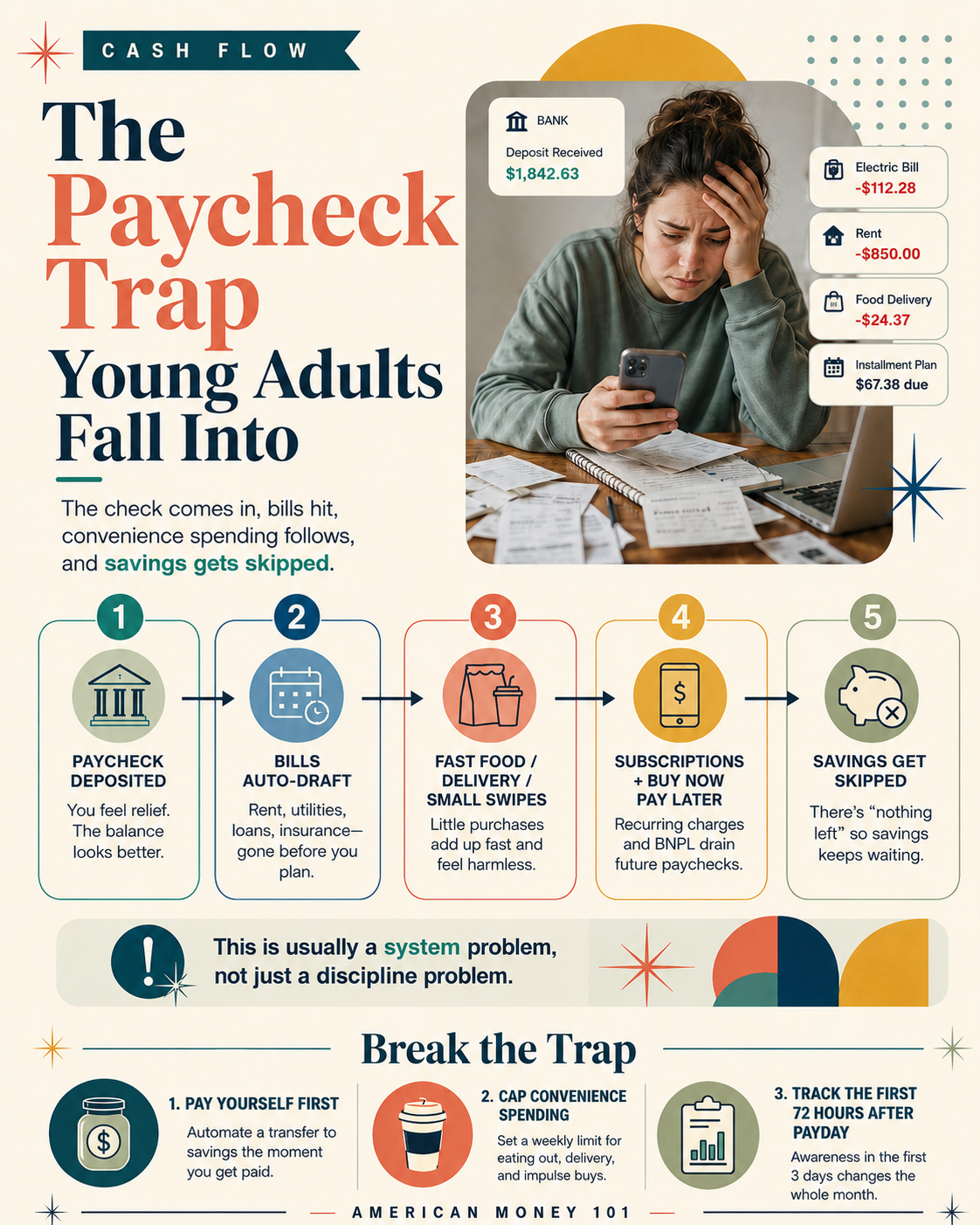
If you feel like your money vanishes the moment it hits your bank account, you are not alone. Many young adults find themselves stuck in a frustrating cycle: the check comes in, bills hit, convenience spending follows, and savings gets skipped. This is often referred to as the paycheck-to-paycheck trap, and it can make building wealth feel impossible.
The good news is that this cycle is usually a system problem, not just a discipline problem. By understanding how the trap works and implementing a few strategic changes to how you manage your cash flow, you can break free and start building a financial cushion.
The 5 Stages of the Paycheck Trap
The paycheck trap typically follows a predictable five-step pattern. Recognizing these stages is the first step toward changing your financial trajectory.
- 1. Paycheck Deposited: You feel relief. The balance looks better. For example, a deposit of $1,842.63 hits your account, and you finally feel like you have some breathing room.
- 2. Bills Auto-Draft: Rent, utilities, loans, and insurance are gone before you plan. Suddenly, that $850.00 for rent and $112.28 for the electric bill take a massive bite out of your balance.
- 3. Fast Food / Delivery / Small Swipes: Little purchases add up fast and feel harmless. A $24.37 food delivery charge here, a coffee there—it doesn't seem like much in the moment.
- 4. Subscriptions + Buy Now Pay Later: Recurring charges and BNPL (Buy Now, Pay Later) drain future paychecks. That $67.38 installment plan due date creeps up on you.
- 5. Savings Get Skipped: There's "nothing left" so savings keeps waiting. You tell yourself you'll save next month, but the cycle simply repeats.
Why It Feels Like a Discipline Problem (But Isn't)
It is easy to beat yourself up when you reach the end of the month with nothing left to save. You might think you just need more willpower. However, relying on willpower alone is a losing battle when your financial system is set up to encourage spending.
When your money sits in a single checking account, it is incredibly easy to lose track of what is earmarked for bills, what is available for spending, and what should be saved. The friction to spend is low, while the friction to save requires a conscious, manual decision every time. To fix this, you need to change the system.
How to Break the Trap
Escaping the paycheck-to-paycheck cycle requires intentional changes to how money flows through your accounts. Here are three proven strategies to break the trap.
1. Pay Yourself First
The most effective way to ensure you save money is to automate a transfer to savings the moment you get paid. Do not wait until the end of the month to see what is left over, because there will rarely be anything left.
Set up an automatic transfer from your checking account to a separate savings account—ideally a high-yield savings account at a different bank to add a layer of friction. Even if it is just $50 a paycheck, automating this process removes the need for willpower and guarantees that your savings grow consistently.
2. Cap Convenience Spending
Convenience spending—like food delivery, rideshares, and impulse buys—is the silent killer of budgets. These small swipes feel harmless individually but can easily consume hundreds of dollars a month.
You do not have to eliminate these purchases entirely, but you should set a weekly limit. Decide on a reasonable amount you can afford to spend on eating out and delivery, and stick to it. Some people find it helpful to move this "fun money" to a separate checking account or use cash to ensure they do not overspend.
3. Track the First 72 Hours After Payday
The first three days after payday are critical. When your account balance is high, it is easy to fall into the "payday millionaire" mindset and make impulsive purchases. Awareness in the first 3 days changes the whole month.
Make a conscious effort to track every dollar you spend during this 72-hour window. By being hyper-aware of your spending when you feel the wealthiest, you can curb the urge to splurge and ensure that your money is directed toward your actual priorities, like bills and savings.
Building Your Cash Flow Cushion
As you implement these strategies, your goal should be to build a cash flow cushion. This means keeping enough money in your checking account to cover at least one month's worth of expenses. Once you achieve this, you are no longer waiting anxiously for the next paycheck to cover rent or groceries. You have broken the cycle, and you can start focusing on larger financial goals.