If you are planning a major financial move in retirement, you might be focused on the immediate tax bill. But there is another hidden cost that catches many retirees off guard: the Medicare Income-Related Monthly Adjustment Amount, or IRMAA. This surcharge can significantly increase your Medicare premiums, and it often arrives as a surprise because of how Medicare calculates your income.
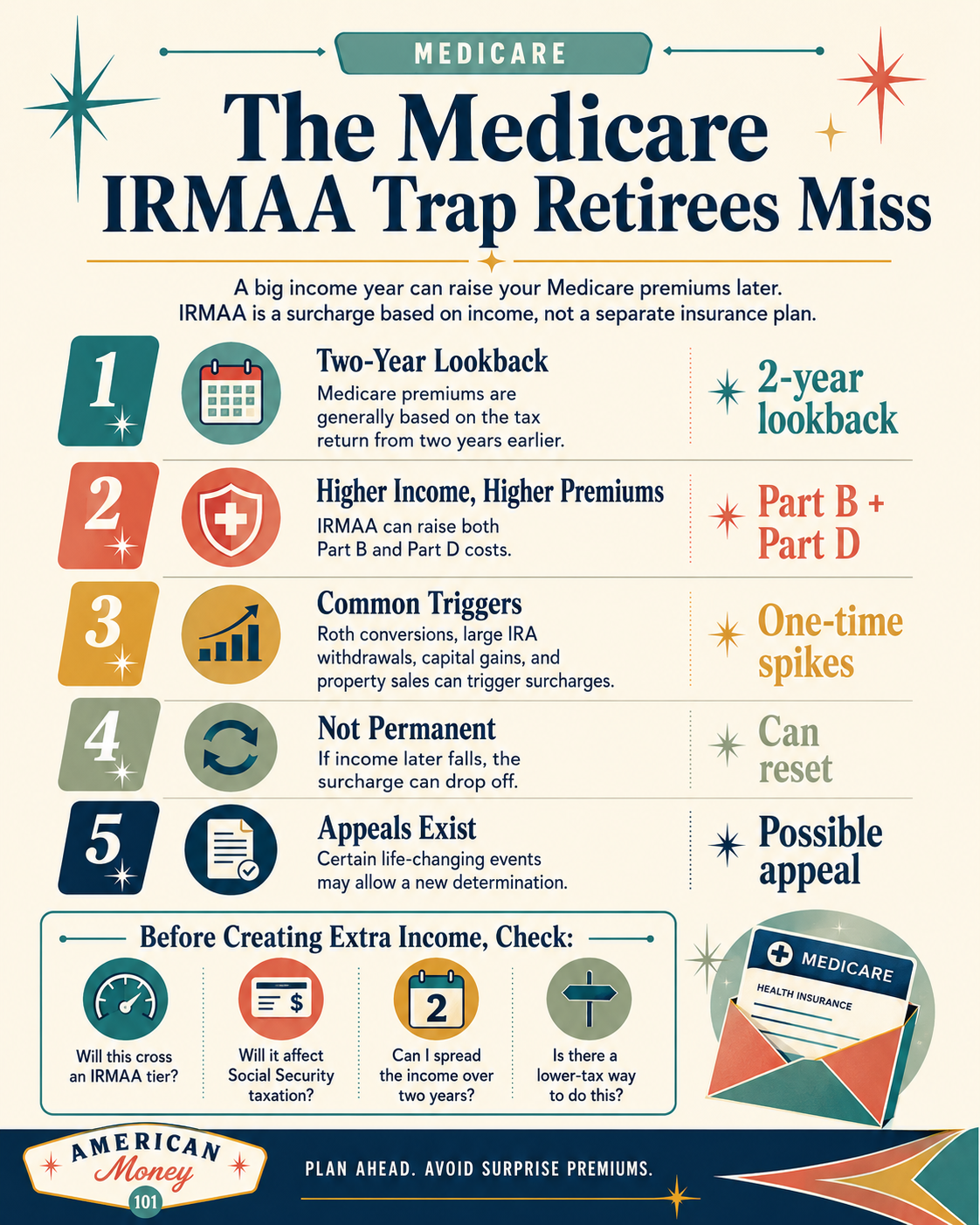
IRMAA is not a separate insurance plan or a penalty for bad behavior. It is simply a surcharge added to your standard Medicare Part B and Part D premiums if your income exceeds certain thresholds. Understanding how this system works can help you plan your retirement income more effectively and avoid unexpected bills.
The Two-Year Lookback
One of the most confusing aspects of IRMAA is the timeline. Medicare does not base your current premiums on your current income. Instead, they use a "two-year lookback" system. The Social Security Administration (SSA) looks at your modified adjusted gross income (MAGI) from your federal tax return filed two years prior.
For example, your 2025 Medicare premiums are based on the income you reported on your 2023 tax return. This delay means that a financial decision you make today could come back to bite you in the form of higher Medicare premiums two years down the road. It requires you to think ahead and anticipate how your current actions will affect your future costs.
Higher Income Means Higher Premiums
If your MAGI exceeds the established thresholds, you will be subject to the IRMAA surcharge. This extra cost applies to both Medicare Part B, which covers outpatient services like doctor visits, and Medicare Part D, which covers prescription drugs.
The thresholds are adjusted annually for inflation. For 2025, the IRMAA surcharge kicks in if your 2023 MAGI was over $106,000 for a single filer or $212,000 for a married couple filing jointly. The surcharge increases in tiers as your income goes up, meaning the more you earn, the more you pay for your Medicare coverage.
Common Triggers for IRMAA
Many retirees hit the IRMAA thresholds not because of a steady high income, but because of a one-time financial event that causes a temporary spike in their MAGI. These common triggers can easily push you into a higher premium bracket for a year:
- Roth Conversions: Moving money from a traditional IRA to a Roth IRA increases your taxable income for the year of the conversion.
- Large IRA Withdrawals: Taking a lump sum out of a tax-deferred retirement account to pay for a major expense, like a home renovation or a child's wedding, will boost your MAGI.
- Capital Gains: Selling a large amount of stock or mutual funds at a profit will increase your income.
- Property Sales: Selling a second home, a rental property, or even your primary residence (if the gain exceeds the exclusion limits) can trigger a significant income spike.
The Surcharge Is Not Permanent
The good news is that IRMAA is not a permanent life sentence. Because it is recalculated every year based on your tax return from two years prior, the surcharge can drop off if your income falls back below the threshold.
If you have a one-time income spike in 2023, you will pay the IRMAA surcharge in 2025. But if your income returns to normal in 2024, your Medicare premiums will drop back down to the standard rate in 2026. It is a temporary increase, but it still requires careful planning to manage the cash flow impact during the year you are subject to the surcharge.
Appeals Exist for Life-Changing Events
What happens if your income drops significantly, but Medicare is still basing your premiums on a high-income year from the past? You do not necessarily have to just pay the higher bill. The SSA allows you to appeal your IRMAA determination if you have experienced a qualifying "life-changing event" that has reduced your income.
Qualifying events include:
- Marriage, divorce, or annulment
- Death of a spouse
- Work stoppage or reduction in hours
- Loss of income-producing property due to a disaster
- Loss of pension income
- An employer settlement payment
If you meet one of these criteria, you can file Form SSA-44 to request a new initial determination based on your current, lower income. You will need to provide documentation of the event and your new estimated income.
Before Creating Extra Income, Check Your Plan
To avoid the IRMAA trap, you need to be proactive about managing your retirement income. Before you make a move that will generate extra taxable income, ask yourself a few key questions:
- Will this cross an IRMAA tier? Check the current IRMAA brackets and estimate how much your planned action will increase your MAGI.
- Will it affect Social Security taxation? Higher income can also cause a larger portion of your Social Security benefits to become taxable, creating a double whammy.
- Can I spread the income over two years? If you are planning a large withdrawal or a Roth conversion, consider splitting it across two tax years to keep your MAGI below the IRMAA threshold in both years.
- Is there a lower-tax way to do this? Explore other options for generating cash, such as tapping into a Roth IRA (which does not affect MAGI) or taking out a loan, rather than triggering a taxable event.
By planning ahead and understanding the rules, you can avoid surprise Medicare premiums and keep more of your hard-earned money in your pocket.
Sources and further reading
- What is the income-related monthly adjusted amount (IRMAA)? | medicareresources.org
- What Is Medicare IRMAA for 2025? | Northwestern Mutual
- Avoiding IRMAA: Tips for Lowering Income-Based Fees
- Medicare’s Income-Related Monthly Adjustment Amount (IRMAA): What to Know - GoodRx
- Medicare Part B Premium Appeals | HHS.gov